Old School Bodybuilding Workouts: The Classic Path to Aesthetics and Strength
In a world where fitness trends come and go with dizzying speed, old school bodybuilding workouts remain a timeless testament to dedication and strength. Picture the iconic physiques of legends like Arnold Schwarzenegger, Mike Mentzer, and Sergio Oliva—bodies that were artfully crafted through sheer hard work and discipline. The symmetrical aesthetics of these champions set a standard that has yet to be surpassed. What makes their approach so appealing? Unlike today’s professional bodybuilders, many of these athletes balanced their rigorous training regimens with full-time jobs, embodying the notion that grit and resilience breed success. By embracing old school bodybuilding workouts, aspiring lifters can tap into this rich heritage of strength and symmetry.
The Philosophy Behind Old School Bodybuilding
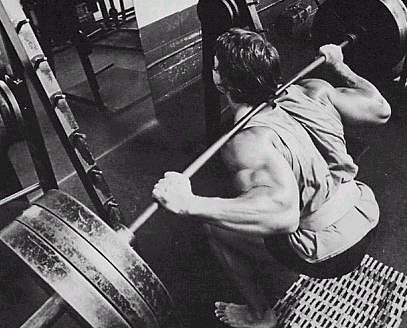
Old school bodybuilding isn’t just about lifting weights; it’s a philosophy rooted in simplicity, consistency, and a deep understanding of the human body’s mechanics. Back in the golden era of bodybuilding, training focused heavily on foundational movements—squats, deadlifts, bench presses—emphasizing the importance of compound lifts over isolation exercises. These legends trained with purpose, understanding that true growth comes from pushing one’s limits. Their workouts weren’t filled with fancy machines or gimmicky supplements; rather, they relied on heavy iron, sweat, and an unwavering drive for excellence.
Adopting this mindset can be incredibly motivational. It reminds us that we too can achieve extraordinary results if we commit to the process, regardless of our current level of fitness or daily time constraints. Let’s dive into the specifics of some exemplary old school bodybuilding workouts from Arnold, Mike Mentzer, and Sergio Oliva that illustrate how these champions sculpted their legendary physiques.
1. Arnold Schwarzenegger’s Classic Split Routine
Arnold Schwarzenegger is perhaps the most recognizable face in bodybuilding history, and his workout regimen is as legendary as his accolades. His classic split routine is structured to hit each muscle group twice a week, allowing for both frequency and recovery. Here’s a glimpse into Arnold’s typical week:
Day 1: Chest and Back
– Bench Press: 5 sets of 10-12 reps
– Incline Dumbbell Press: 5 sets of 10-12 reps
– Pull-Ups: 5 sets to failure
– Bent-Over Barbell Row: 5 sets of 10-12 reps
Day 2: Legs
– Squats: 5 sets of 10-12 reps
– Leg Press: 5 sets of 10-12 reps
– Lunges: 5 sets of 10-12 reps
– Calf Raises: 5 sets of 12-15 reps
Day 3: Shoulders and Arms
– Military Press: 5 sets of 10-12 reps
– Dumbbell Lateral Raise: 5 sets of 10-12 reps
– Barbell Curl: 5 sets of 10-12 reps
– Triceps Dips: 5 sets of 10-12 reps
Arnold’s philosophy was built around “pumping” the muscles, ensuring that each workout left a lasting impression. He believed in the importance of visualization—“You have to see yourself as a champion before you become one.” This principle encourages lifters to embody their goals, making every workout a step closer to mastery.
2. Mike Mentzer’s Heavy Duty Approach
On the opposite end of the spectrum was Mike Mentzer, who introduced a revolutionary approach known as Heavy Duty. Unlike the traditional high-volume training, Mentzer advocated for lower volume but higher intensity, focusing on achieving maximum effort in minimal time. His philosophy stemmed from the belief that muscles only grow when they are fully exhausted.
A typical workout for Mentzer might look like this:
Chest and Arms:
– Flat Barbell Bench Press: 1-2 sets of 6-8 reps (to failure)
– Dumbbell Flyes: 1 set of 8-10 reps
– Barbell Curls: 1 set of 6-8 reps (to failure)
– Triceps Extensions: 1 set of 6-8 reps (to failure)
Legs:
– Squats: 1-2 sets of 6-8 reps (to failure)
– Leg Extensions: 1 set of 8-10 reps
– Deadlifts: 1-2 sets of 6-8 reps (to failure)
Mentzer’s Heavy Duty mentality taught lifters that quality trumps quantity. This makes it a great approach for those balancing work and life, as the focus is on shorter, more effective training sessions.
3. Sergio Oliva’s All-Round Training Regimen
Sergio Oliva, known for his incredible symmetry and proportionality, combined traditional lifts with a variety of techniques to attain his jaw-dropping physique. His workouts included not only heavy weights but also rhythmic movements that enhanced his overall aesthetic.
Here’s a sample of Oliva’s training:
Back and Biceps:
– Chin-Ups: 4 sets to failure
– Barbell Rows: 4 sets of 8-10 reps
– Dumbbell Hammer Curls: 4 sets of 10-12 reps
Legs:
– Squats: 5 sets of 8-10 reps
– Leg Curls: 4 sets of 10-12 reps
– Standing Calf Raises: 5 sets of 12-15 reps
Chest and Shoulders:
– Incline Barbell Press: 5 sets of 8-10 reps
– Lateral Raises: 4 sets of 10-12 reps
– Push-Ups: 3 sets to failure
Oliva’s method emphasized the mind-muscle connection, urging lifters to feel and visualize the muscles working during each phase of movement. This holistic approach studiously balances strength training with technique and form, reinforcing that motivation often stems from the relationship one builds with their own physical self.
Conclusion: Embracing the Legacy of Old School Bodybuilding Workouts
In a rapidly evolving fitness landscape dominated by instant results and quick fixes, the principles of old school bodybuilding offer a refreshing reminder of the roots of strength training. Legends like Arnold, Mike Mentzer, and Sergio Oliva showcased how hard work, dedication, and a commitment to quality training could yield extraordinary results.
So, whether you have a busy job or a packed schedule, integrating aspects of these old school bodybuilding workouts can enrich your fitness journey. Remember that every rep counts, and staying true to a structured, disciplined routine, even amidst daily responsibilities, can help you achieve the body you envision. As you lift, channel the spirit of these icons—their tenacity and passion can ignite your own path toward greatness. Lift with heart, lift with intent, and embrace the art of bodybuilding!